Introduction: The Giant Who Changed History
When justice is mentioned, Umar is mentioned. When strength in truth is mentioned, Umar is mentioned. "Umar ibn Al-Khattab" was not just a Caliph; he was an "institution" that produced leaders and governors. In the days of ignorance (Jahiliyyah), he was harsh and tough. But when faith touched his heart, that mighty giant turned into the "most merciful" towards the weak and the sternest against oppressors. He is the one through whom Allah distinguished between Truth and Falsehood, earning him the title "Al-Faruq." He established the Hijri calendar, organized the state ministries (Diwans), and personally patrolled the streets at night to guard his people. In this article, we will journey with this towering figure to see how faith can perform miracles in human souls.
The Story of His Conversion (The Turning Point)
Umar once walked through Makkah with his sword drawn, intending to kill Prophet Muhammad (PBUH). But the Prophet's prayer had preceded him: "O Allah, strengthen Islam with one of the two men most beloved to You: Abu Jahl or Umar ibn Al-Khattab."
On his way, he diverted to his sister Fatimah's house to punish her for converting. There, he heard verses from "Surah Taha." The mountain shook, his neck humbled, and the sword dropped. He went to the Prophet (PBUH) not to kill him, but to say: "I bear witness that there is no deity but Allah." That day, Muslims shouted "Allahu Akbar" so loud it shook Makkah, and they prayed openly at the Kaaba for the first time. His conversion was a "victory" for Islam, as Ibn Masoud said.
Moments Immortalized in History
1. Umar's Intuition (Muwafaqat):
Umar would often hold an opinion, and the Quran would be revealed agreeing with him! He suggested taking the Station of Ibrahim as a place of prayer, and the verse was revealed. He suggested Hijab for the Prophet's wives, and the verse of Hijab was revealed. The Prophet (PBUH) said: "In nations before you, there were people who were inspired (Muhaddathun). If there is anyone in my Ummah, it is Umar."
2. Justice That Exhausted His Successors:
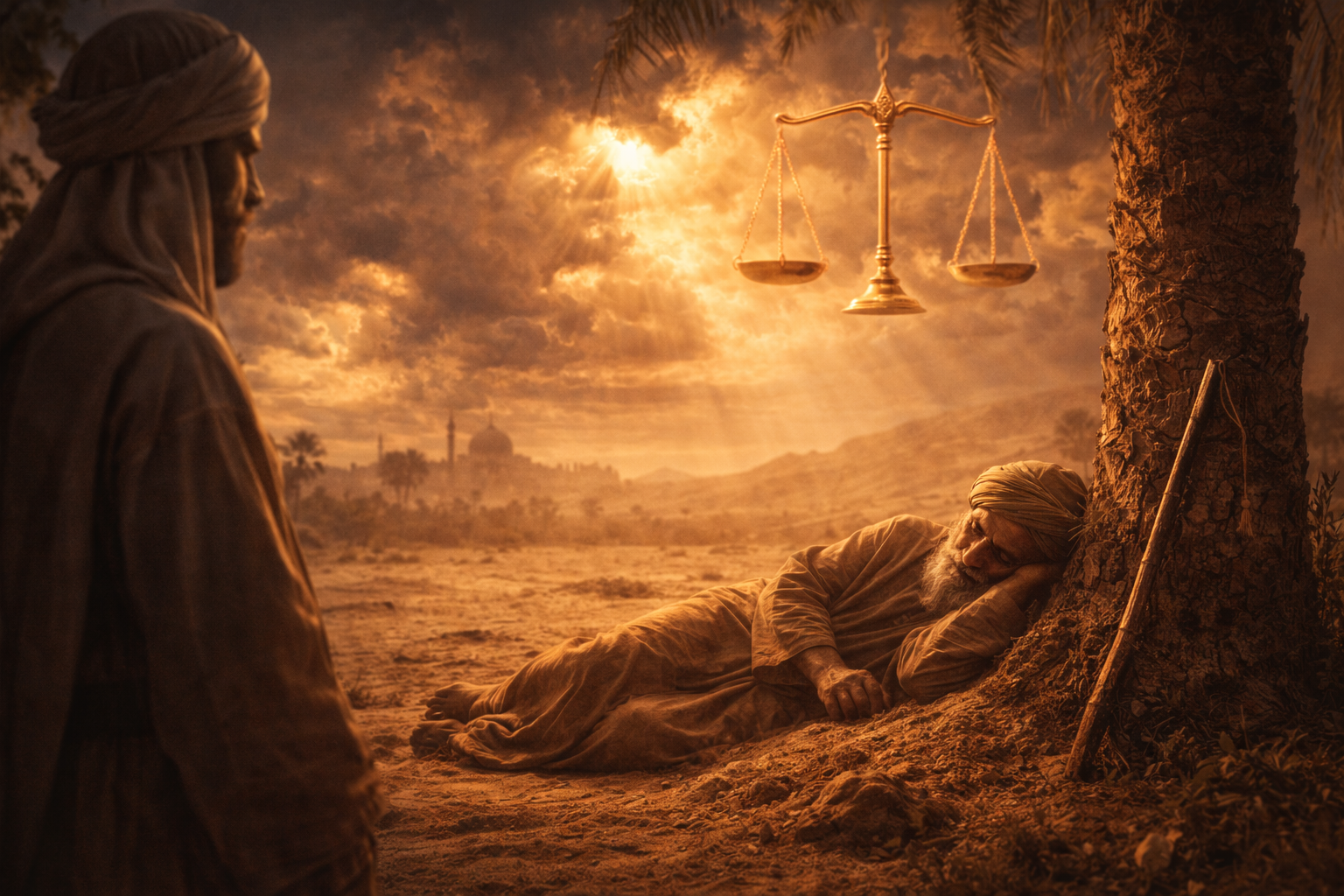
An envoy from the Persian Emperor came to see the "King of Muslims," expecting a palace and guards. He found Umar sleeping under a tree, with no guards, sweating on the dirt. He said his famous words: "You ruled, you were just, so you felt safe, and thus you slept, O Umar."
Another example is the story of the Copt (Egyptian Christian) whose son was beaten by the son of Amr ibn Al-Aas (Governor of Egypt) after losing a race. The Copt traveled to Madinah to complain. Umar summoned the Governor and his son, gave a whip to the Copt, and said: "Strike the son of the noble ones." Then he famously said: "Since when have you enslaved people when their mothers bore them free?"
3. Umar and Responsibility:
He would cry at night saying: "By Allah, if a mule were to stumble in Iraq, I fear Allah would ask me about it: Why did you not pave the road for it, O Umar?" This was not fear of people, but certainty that leadership is a heavy burden accountable on Judgment Day.
4. The Year of Ashes (The Hungry Leader):
When famine hit Madinah, Umar forbade himself from eating meat or ghee (butter) until the poor Muslims were fed. His skin turned dark, and his stomach rumbled from hunger. He would tap his belly and say: "Rumble or do not rumble, by Allah, you will not be full until the children of Muslims are full." This is a true leader who starves before his people and eats after them.
Administrative Achievements (Founder of the State)
Umar was not just a worshipper; he was a brilliant "Statesman":
- He established "Diwans" (Ministries) to organize salaries and the army.
- He created the "Hijri Calendar" which we use today.
- Under his rule, major conquests (Qadisiyah, Yarmouk, Jerusalem) occurred. He personally received the keys to Jerusalem and wrote the "Pact of Umar," a historic document of religious tolerance.
His Martyrdom (The End of the Lion)
He used to pray: "O Allah, grant me martyrdom in Your path and let my death be in the city of Your Messenger." People wondered: How can you be a martyr inside Madinah (the safe capital)? But Allah answered him. While leading Fajr prayer, "Abu Lu'lu'ah the Magian" stabbed him with a poisoned dagger. When Umar learned his killer was not a Muslim, he said: "Praise be to Allah who did not make my death at the hands of a man who prostrated to Allah even once, lest he argue with me before Allah."
Conclusion: We Miss You, O Umar!
May Allah have mercy on Umar. He filled the earth with justice and left us a legacy to be proud of. He left no dinars for his children, but he left them and us the "Dignity of Islam." Today, we need to read his biography more than ever, to learn that Truth is strong, Justice is the foundation of governance, and that Allah raises nations by this Book and lowers others by it.